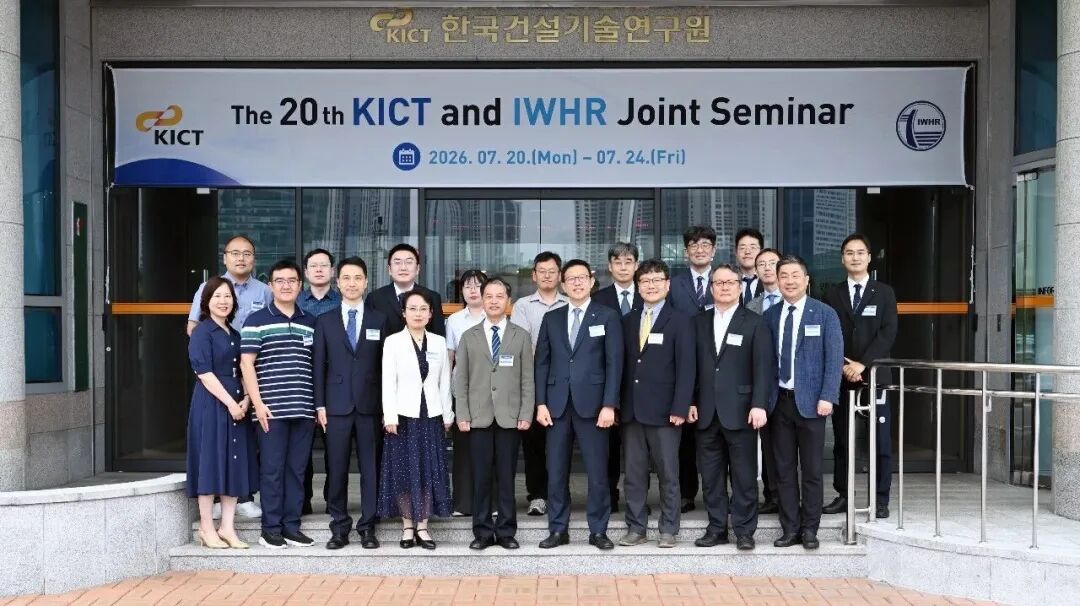
The 20th IWHR-KICT Joint Seminar, co-hosted by IWHR and the Korea Institute of Civil Engineering and Building Technology (KICT), took place from July 21 to 24 in South Korea. Dr. Jiang Yunzhong, Vice President of IWHR, led a delegation of experts to attend the Seminar and participate in technical field visits.
In his opening speech, Jiang congratulated both sides on the 20th edition of the Seminar, a long-standing mechanism for academic exchanges between the two institutes. Through the joint efforts of both sides, the event has developed into an important platform for sharing research outcomes, exchanging innovative ideas, and deepening practical cooperation, he noted.
Jiang said that global climate change and emerging technologies have brought both new challenges and new opportunities. China’s water sector, he noted, has actively followed a water governance approach centered on prioritizing water conservation, reaching spatial equilibrium, adopting systematic approaches, and leveraging the roles of both government and market, achieving a series of new advances and breakthroughs. IWHR, he said, is ready to further strengthen cooperation with Korean counterparts in joint research, technology sharing, talent development, and other areas, and to work together to promote innovation in water science and engineering and contribute knowledge and solutions to regional and global water security.
Dr. Moon Byungsup, Vice President of KICT, reviewed the history of sustained scientific exchanges and research sharing between the two institutes since the signing of their cooperation agreement in 2002. He noted that, in the face of global challenges such as climate change, natural disasters, and resource scarcity, strengthening international scientific cooperation is of great importance. He expressed the hope that the two sides deepen exchanges in key areas such as water resources management and disaster prevention and mitigation, and further strengthen their long-standing partnership.
Ten experts from IWHR and KICT delivered technical presentations and exchanged views on ongoing work.
During the visit, the IWHR experts also visited the Sihwa Lake Tidal Power Station in Ansan, the Andong River Experiment Center of KICT, and the Seoul Water Recycling Corporation to discuss technical research and project cooperation.
