Since the launch of the national pilot program for water budgeting management in 2024, the Ministry of Water Resources has coordinated and advanced 20 national-level and 78 provincial-level pilot projects, generating a number of replicable and scalable practices.
At its core, the water budgeting management incorporates the concept offiscal budgeting into the whole-process management of water resources. By the approach of “Water Should be Managed Like Money”, it aims to realize meticulous management and efficient allocation of water resources.
As one of the country’s first provincial-level pilot regions for water budget management, Ningxia took the lead in incorporating relevant provisions on water budgeting management into local legislation. It has been adopted at the autonomous region, municipal, and county levels under a process covering “preparation, review, issuance, implementation, adjustment, and final accounting”, significantly improving water-use efficiency.
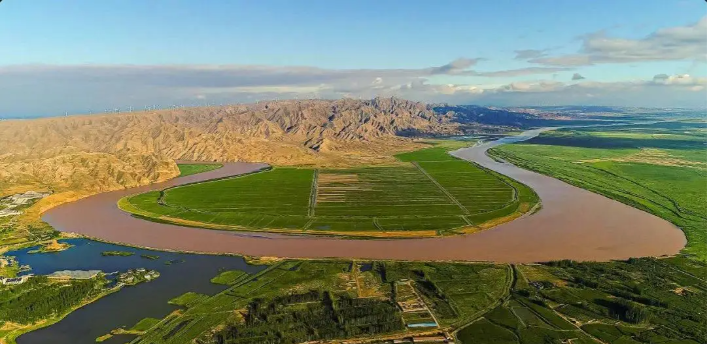
The Yellow River irrigation zone in Ningxia [Photo / Xinhua]
As the country’s first pilot basin for cross-provincial water budgeting management, the Liaohe River Basin has established a four-tier management framework covering the basin, provincial, prefectural, and county levels, achieving full coverage of water budgeting management across four provinces (autonomous regions), 18 prefecture-level administrative regions, and 60 county-level administrative regions within the basin.
Following the principle of “reasonably budgeting surface water, controlling groundwater budgets, and giving priority to unconventional and inter-basintransferred water,” Hebei Province has promoted the efficient allocation of water resources. In 2026, it reduced local authorities’ proposed water budgets by 720 million cubic meters and increased the budget of unconventional water resources by 160 million cubic meters.
Shandong Province has established a water budgeting management information system that automatically issues early warnings when a water user’s consumption reaches 80 percent of its annual water budget, enabling whole-process monitoring, early warning, and traceability in water budgeting management.
Pilot regions have also actively explored market-based approaches to improving the utilization efficiency of existing water resources. For example, Dezhou City in Shandong Province has explored on setting up municipal- and county-level “water banks” to aggregate surplus water volumes from agricultural users and enterprises and optimize their allocation across regions and sectors. Wuhai City in the Inner Mongolia Autonomous Region has guided enterprises with water budget surplus to participate in water rights trading as a means to invigorating the water market. Many localities have also supported major water users in carrying out water-saving upgrades through fiscal subsidies, green finance and other measures.
(Source: INTCE)
